I'm a Freediver Now
“So how did you get into freediving??”
I’ve been asked this more than a handful of times, and my answer always turns into a long-winded backstory instead of something concise. So here is the written TLDR version, for those who are curious.
Half of my genetics are my dad’s—a surfing, swimming waterman born and raised in Hawaii. He told me how his father taught him to swim in Honokōwai, Maui, back in the late 1940s. My dad—just a few years old—was dropped off a small boat onto the furthest reef and told to swim back to shore on his own. That Pacific Islander intuition-slash-trauma bond with the ocean is in my DNA.
My parents thought it was essential that my sisters and I become strong swimmers. I was on swim team from age 8 through high school, and I became a good swimmer, but I never cared much about speed or competition. I just liked being in the water. My favorite part of practice was always the end—when the lane lines came out and I had a few minutes to send a few flips off the high dive.
I grew up in the San Francisco Bay Area, where the ocean isn’t exactly welcoming. My dad tried to teach us to surf, but we mostly just got slammed in cold, dark water by his heavy fiberglass longboard.
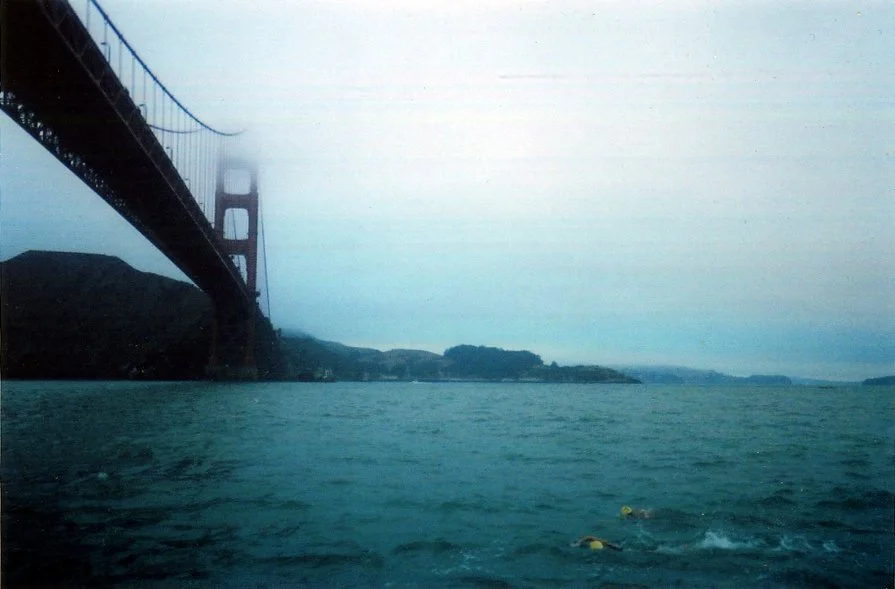
Swimmers under the Golden Gate bridge after I bailed on the swim.
In my twenties, an old friend from high school (who was also on the swim team) convinced me to start open water swimming in San Francisco’s Aquatic Park. The water was freezing and murky, but for whatever reason I was in (being able to use the sauna at the South End Rowing Club after swims sweetened the deal). Over time, I built up tolerance to longer and longer swims in 50–60°F (10-16°C) water, eventually ditching the wetsuit altogether.
Just when I started to feel confident, I realized I wasn’t. At all.
I started to have panic attacks. One after jumping off the pier in Aquatic Park, with no way out except a quarter-mile swim. Another under the Golden Gate Bridge after jumping off a boat to attempt the mile-long crossing. I panicked, bailed, and flagged down a support boat. Swim over.
Shortly after, in 2010, I moved to Los Angeles and continued having frequent panic episodes. I’d never experienced anxiety like that before, but something about having put myself in unpredictable water with no quick exit flipped a switch. And it didn’t stay contained to the ocean. It followed me—to tunnels, traffic on bridges, stalled subway cars, Disneyland rides. Anywhere I felt trapped without a quick exit.
People say “what doesn’t kill you makes you stronger.” Which for a long time annoyed me.
It felt more like: what doesn’t kill you gives you crippling anxiety that something eventually will.
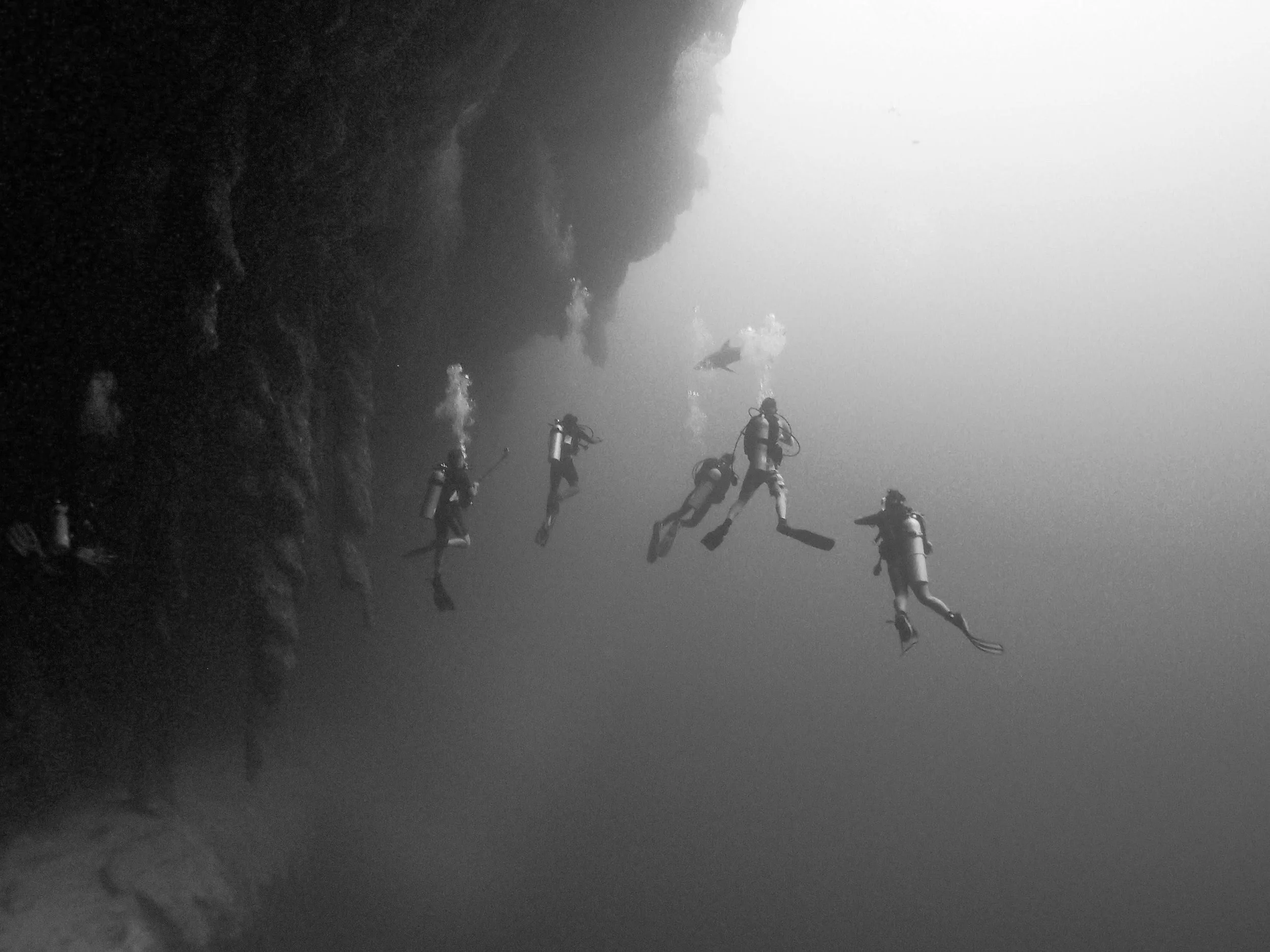
Diving 140 feet underwater at the Great Blue Hole in Belize. I was terrified.
It took years for that anxiety to ease, and it never fully went away. Over a decade later, turbulence, long tunnels, deep dives, remote wilderness, big ocean swells—those things would still spike my heart rate and narrow my vision.
So what did I do? I kept putting myself in those situations. Again. And again. And again.
I flew constantly. I scuba dived. I backpacked at altitude. I surfed, swam, sailed. I panicked, cried, tried breathing techniques, ran through grounding exercises. I got prescribed a low dose of lorazepam and carried it everywhere. Taking it felt like hitting an anxiety mute button—which was helpful to have in my pocket, even though I rarely resorted to taking it.
At one point I got really into surfing, determined to make my dad proud. I’ve probably put in close to 100 days, and got decent at catching waves. But anything bigger than a mellow two-footer, and my heart rate would spike and I’d paddle for my life back to shore.
Same with scuba diving. I’ve logged around 60 dives, including advanced and deep dives—but if I think too much about depth, I can still psych myself out. One of the only full blown panic attacks I’ve experienced was while 120 feet underwater in Malta. It came out of nowhere, and wow what a terrible place to lose one’s shit.
I started creating these imaginary limits—what waves were too big, what depths were too deep, how far from shore was too far. I stayed inside them like they were real. It didn’t stop me from doing these things, but it drained the joy out of them.
Maybe that was the point. I wasn’t chasing fun—I was chasing fear, challenge, growth.
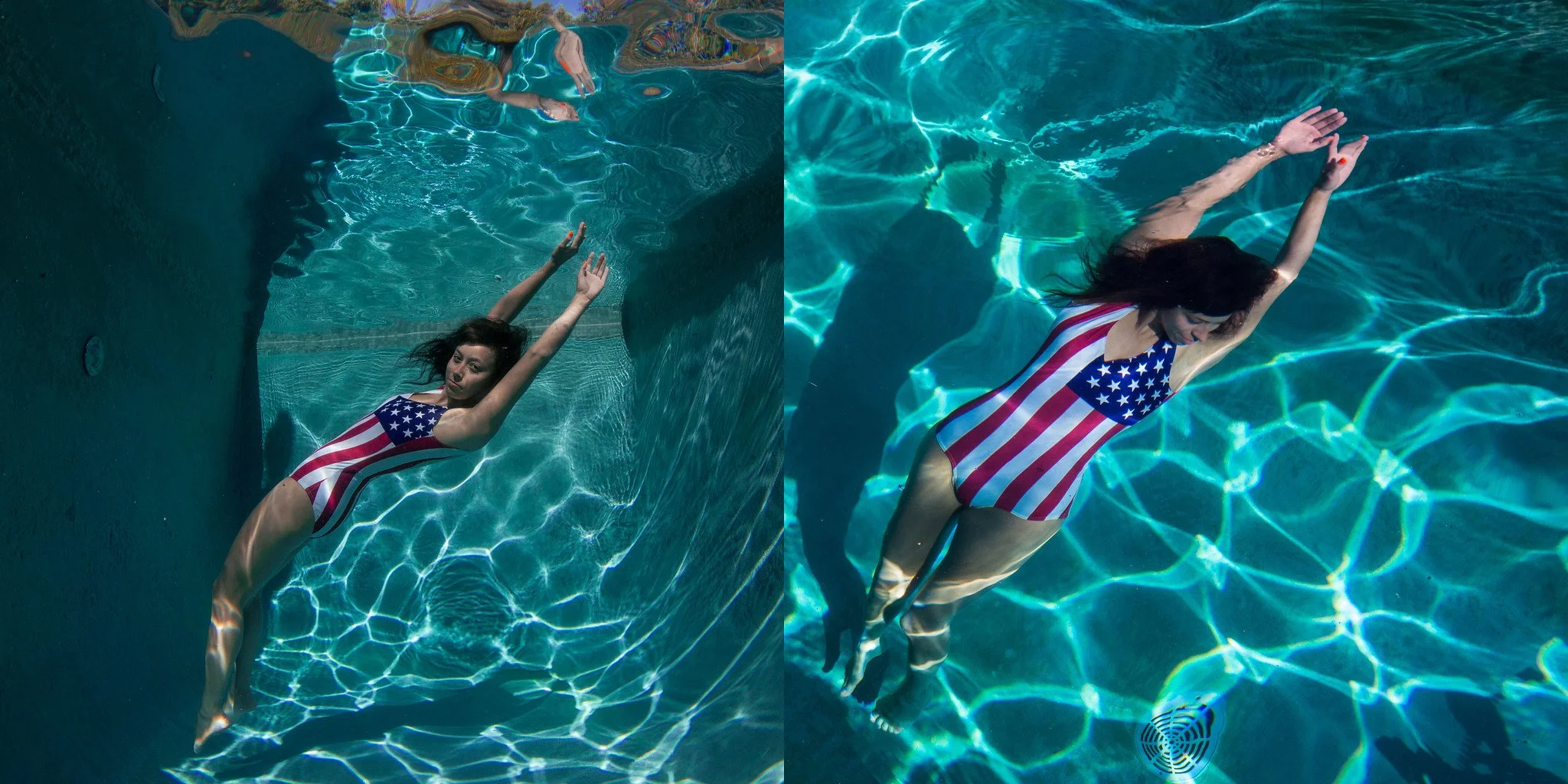
A shoot for fun by my friend Dan Kitchens in 2013. At the time he commented on how I was great at holding my breath.
So… freediving.
I don’t remember exactly when it entered my radar. I knew about spearfishing, but that never interested me. Years ago, a friend took a breath-hold class with some freediving guru while working on an underwater set for a huge-budget movie. After just one session, he could hold his breath for over three minutes. That stuck with me.
I thought maybe if I could hold my breath longer, I wouldn’t be so afraid of getting held down by a wave while surfing, or drowning in the ocean (a fear that I hold despite being a strong enough swimmer that I can swim nonstop for literal miles).
Over time, I saw The Big Blue (Le Grand Bleu) and later The Deepest Breath. They showed me this world of freediving that was both terrifying and strangely compelling.
And it stayed in the back of my mind. I keep a running wish list in my notes app, and for years “take a freediving course” sat there untouched. Then one day I saw a friend in the Red Sea doing exactly that—and it became the excuse I’d been waiting for to finally go to Egypt.
Learning to Freedive
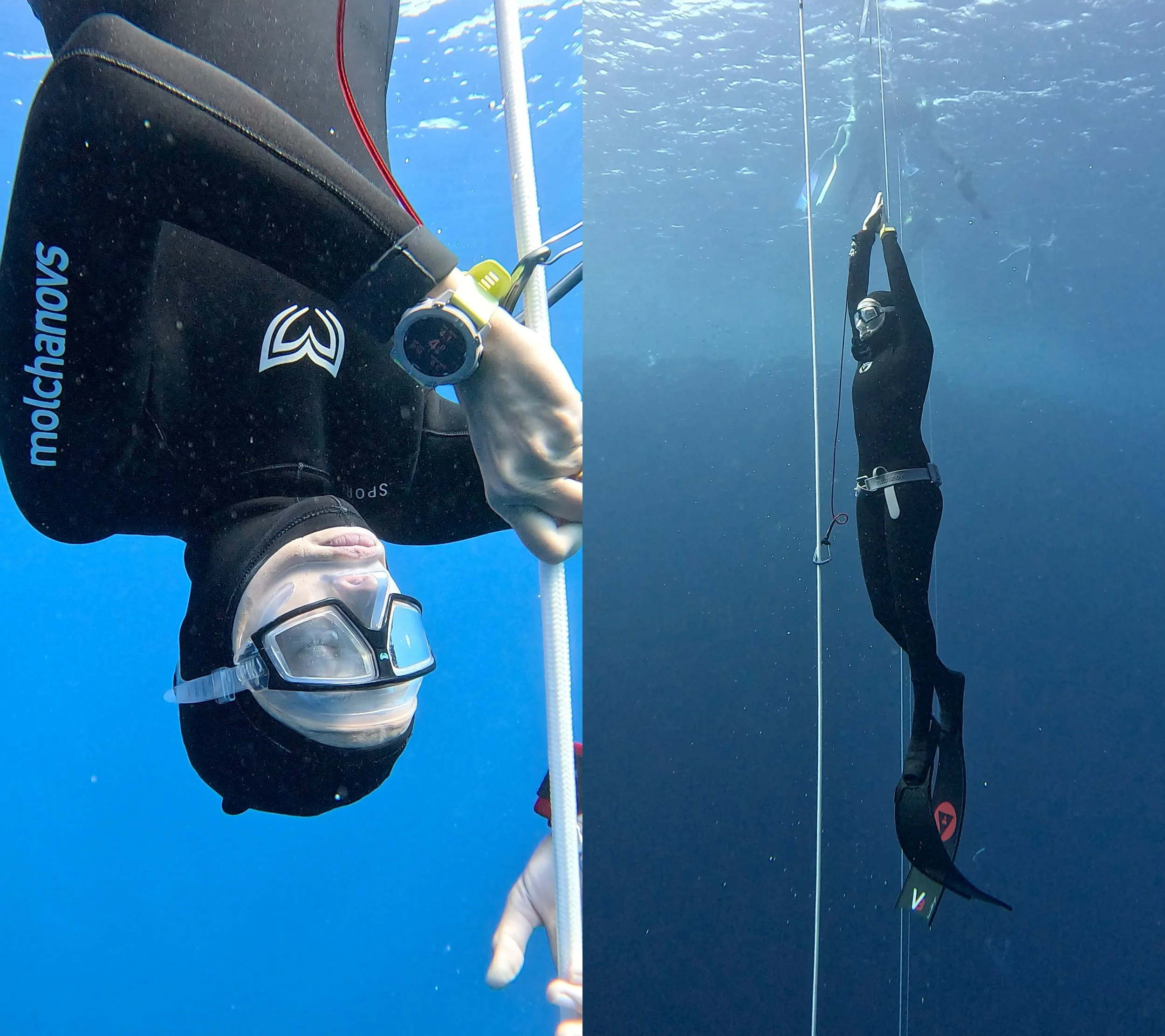
Video stills of me freediving in Dahab’s Blue Hole.
The intro freedive course (oddly called AIDA 2) starts with learning a bit about anatomy—how your lungs work, what happens to your body under pressure at different depths—followed by learning how to relax and breathe. Most of the time we are shallow breathers, using only our chest, but to utilize your full lung volume you need to properly engage your diaphragm and “belly breathe.”
One of the most important things you learn early on is that you should never hyperventilate before a dive. A lot of us have practiced holding our breath and learned the trick that if you breathe really fast beforehand, it feels like you can hold your breath longer. But it’s dangerous. You’re essentially delaying your body’s built-in alarm system for rising CO₂ levels, which means you can black out underwater without warning—and ultimately risk drowning.
So the rule is simple: relax and breathe calmly and naturally, take one full deep breath, and then hold it.
Once we got into the water, I was honestly surprised by how quickly things started to click. I was learning all of this with my instructor, Coach Bambino—a fun, charismatic and hunky Egyptian guy who had left behind a life as a successful but unfulfilled architect to pursue freediving, and now teaches in the Red Sea town of Dahab.
I started ticking off the requirements for my AIDA 2 course pretty quickly. After learning proper relaxation and preparation breathing, I could hold my breath for 2 minutes and 58 seconds out of the water. In the pool my static was a bit lower at 2:26, but I made it 48 meters on a dynamic (swimming the length of the pool underwater with long fins).
Then we moved into open water. Free immersion is a type of freediving where you pull yourself down and back up along a weighted rope. On my first session, I made it to around 15 meters (about 50 feet) deep, which already felt surreal. By day two, I hit my longest dive—1 minute 32 seconds.
What became clear very quickly is that freediving is not about pushing—it’s about doing less. Relaxing, meditating, and basically not thinking is the foundation. The second your mind starts going—life stress, overthinking depth, ego chatter—you burn oxygen faster and everything falls apart. You have to slow your heart rate and stay present before and throughout the dive.
I assumed I would be bad at this because of my anxiety, but something was clicking. Being underwater was actually forcing me—for short spans of time—to calm my mind. And as a result, not breathing felt… really good.
I didn’t expect to do so well or to like freediving this much, so I decided to continue on to AIDA 3 to learn how to go deeper. And that’s when things got more challenging.
The next day, the weather turned windy and the surface was choppy. Just relaxing on the surface between dives became difficult, and I could feel that tension carrying into the water. I still reached a new max depth of 19.2 meters, but I was struggling with anxiety in my mind, and tension in my body.
The following day, I hit a wall. I was trying to get to 24 meters, but everything past 20 didn’t feel good. At that depth, your lungs are significantly compressed—half their volume at 10 meters, one-third at 20, one-quarter at 30—and it’s something you have to both physically adapt to and mentally relax through. The feeling of compression felt very foreign and scary, so I was resisting.
My deepest dive that day was 21.2 meters, and I came up with an intense tension headache that lingered for the rest of the day. Being the hypochondriac that I can be, I feared these new sensations in my body were somehow dangerous… but a little advil, rest, and water turned out to be all I needed.
The next day, I changed my approach. I stopped looking at the depth on my dive watch. Thinking about depth and time adds a lot of anxiety for me—it creates those imaginary limits I’ve always operated within. I needed to dive based on what my body was telling me, not numbers.
On the final dive of my training, I knew the stopper was set deeper than I’d ever gone. I pulled down, trying to stay relaxed as the pressure built in my chest. I thought I was getting close to 24 meters, but I stopped and turned a meter or two early. The pressure felt like too much, and suddenly I thought about how far I was from the surface.
My mind started racing, and I couldn’t breathe to calm myself down.
The panic gave me a strong urge to breathe and kicked hard for the surface—the exact opposite of what you’re supposed to do. It was scary. It was ugly.
But as soon as I surfaced, I was fine. After my recovery breaths, Coach Bambino told me to look at my watch—24.7 meters.
He had intentionally set the stopper at 26 meters. He knew that “too far” in my head was short of my actual limit, so he placed it a couple meters deeper than the goal.
I thought I had fallen short—but I had done what I came there to do.
In just ten days, I went from never having freedived to completing both AIDA 2 and AIDA 3.
I went into it thinking I needed to learn how to hold my breath—but what I actually needed was to stop fighting myself long enough to see what I was already capable of. I needed to learn how to separate real signals from noise, and know that my body can do very hard things when my mind believes it can.
Since starting in October 2024, I’ve kept training and have since reached a max depth of 37 meters (122 feet)—which I did on a return trip to Dahab, diving again with Coach Bambino, where he tricked me into going deeper than the 35 meters I thought I was aiming for.