I’m a Freediver Now (A Story About Fear)
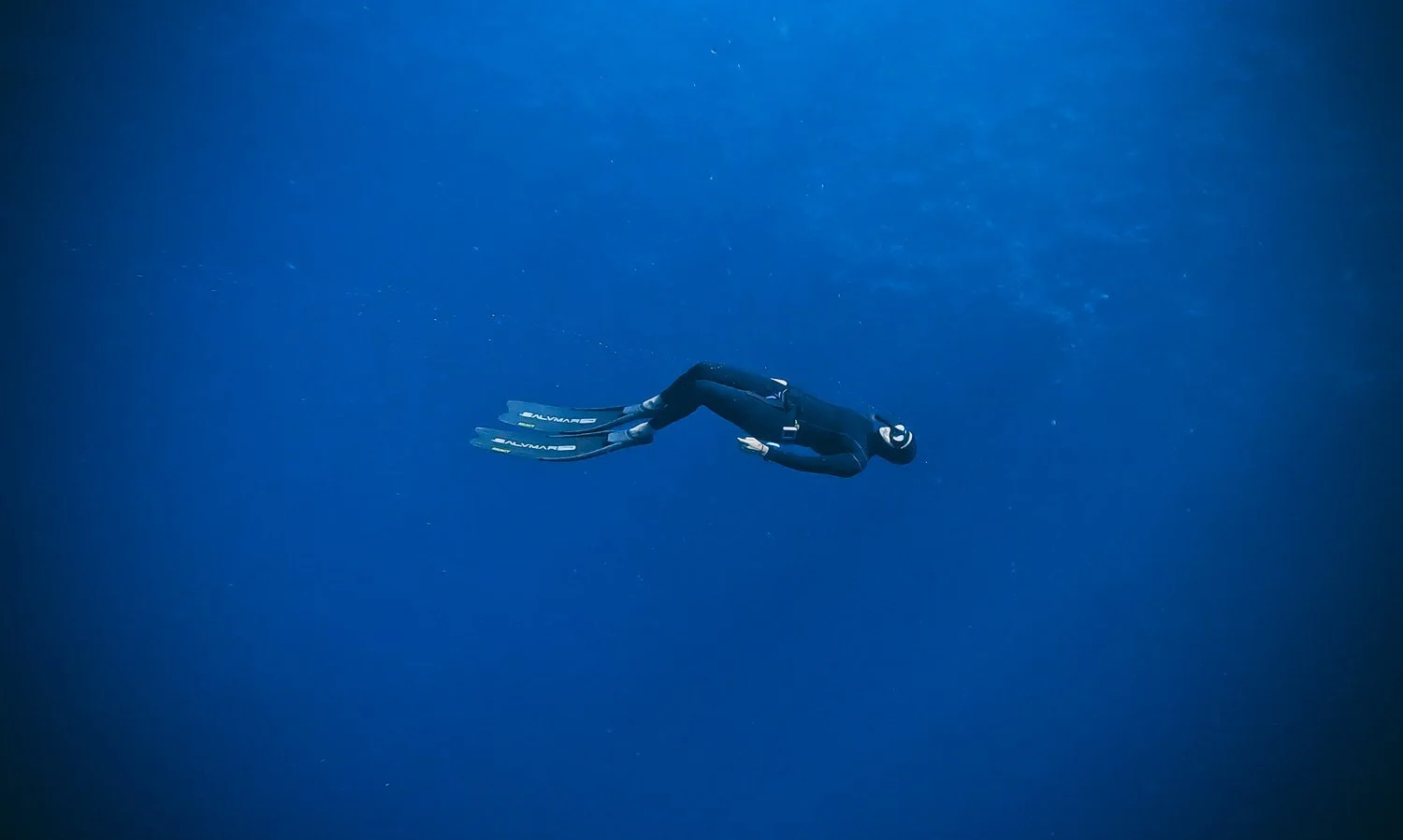
“So how did you get into freediving??”
I’ve been asked this more than a handful of times, and my answer always turns into a long-winded backstory instead of something concise. So here is that TL;DR version, for those who have the attention span to read it.
Half of my genetics are my dad’s—a surfing, swimming waterman born and raised in Hawaii. He told me how his father taught him to swim in Honokōwai, Maui, back in the late 1940s. My dad—just a few years old—was dropped off a small boat onto the furthest reef and told to swim back to shore on his own. That Pacific Islander intuition-slash-trauma bond with the ocean is in my DNA.
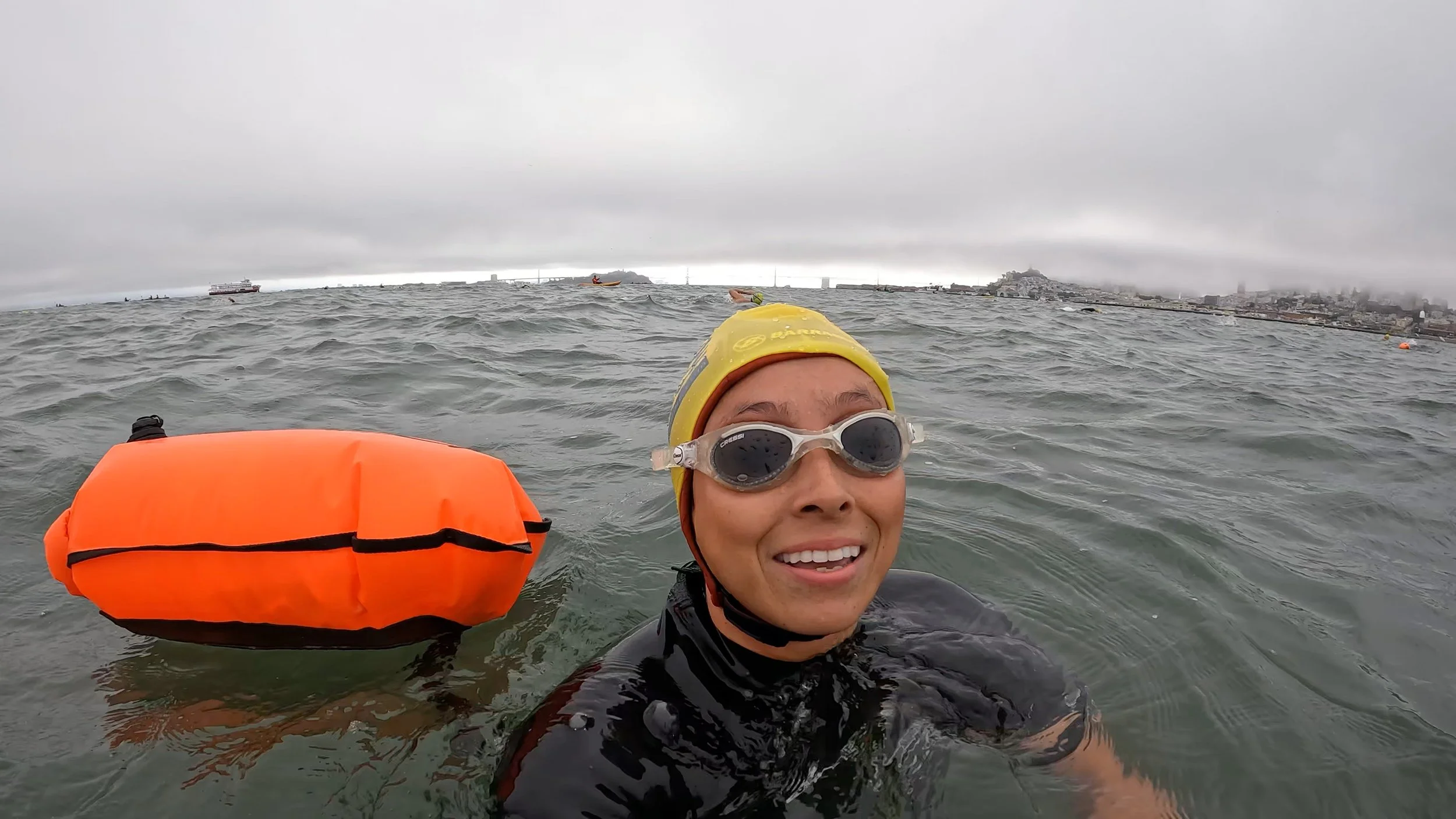
Swimming from Alcatraz in the San Francisco Bay, September 2024
My parents thought it was essential that my sisters and I become strong swimmers. I was on swim team from nine or ten through high school, and I became a good swimmer, but I never cared much about speed or competition. I just liked the feeling of being in the water. My favorite part of practice was always the end—when the lane lines came out and I had a few minutes to send some flips off the high dive.
I grew up in the San Francisco Bay Area, where the ocean isn’t exactly welcoming—it’s cold, dark, and murky. My dad tried to teach us to surf in Pacifica (our hometown), but after falling off, getting rolled by a wave, and taking his heavy fiberglass longboard to the head once, I lost any desire to learn.
In my twenties, an old friend from high school (who was also on the swim team) convinced me to start open water swimming in San Francisco’s Aquatic Park. It was that same cold, dark, uninviting water, but for whatever reason I was in (being able to use the sauna at the South End Rowing Club after swims sweetened the deal). Over time, I built up tolerance to longer and longer swims in 50–60°F (10-16°C) water, eventually ditching the wetsuit altogether.
Just when I started to feel confident, I realized I wasn’t. At all.
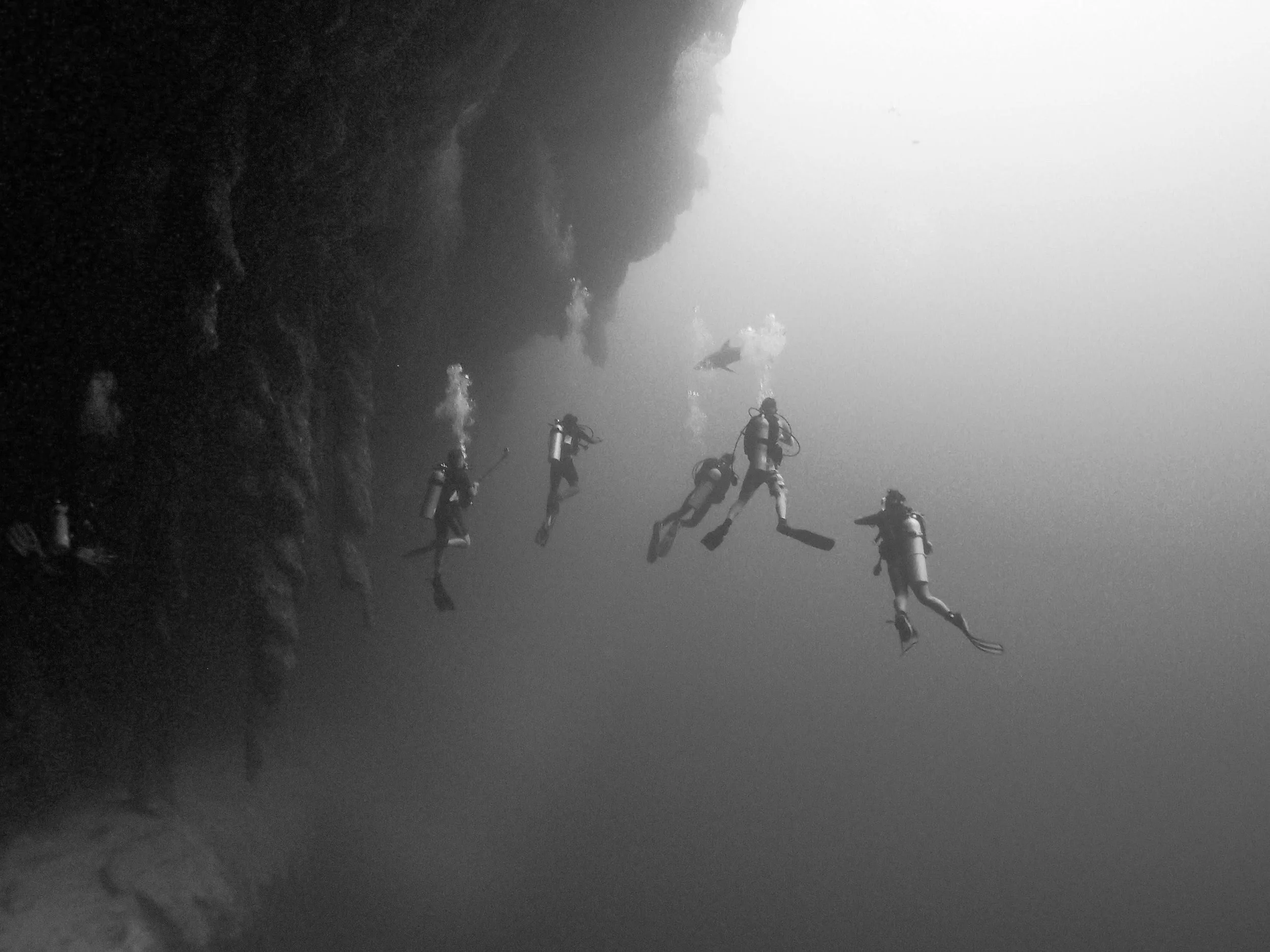
Photo I took while diving 140 feet underwater at the Great Blue Hole in Belize in 2014. I was terrified (and a little medicated to deal with it).
I started to have panic attacks. One after getting cold shock from jumping off the pier in Aquatic Park, with no way out except a quarter-mile swim. Another under the Golden Gate Bridge after jumping off a boat to attempt the mile-long crossing. I panicked, bailed, and flagged down a support boat.
Shortly after, in 2010, I moved to Los Angeles and continued having frequent panic episodes. I’d never experienced anxiety like that before, but something about having put myself in unpredictable water with no easy exit flipped a switch. And it didn’t stay contained to the ocean. It followed me—to tunnels, traffic on bridges, stalled subway cars, Disneyland rides. Anywhere I felt trapped without a quick exit.
People say “what doesn’t kill you makes you stronger.” Which for a long time annoyed me.
It felt more like: what doesn’t kill you gives you crippling anxiety that something eventually will.
It took years for that anxiety to ease, and it never fully went away. Over a decade later, turbulence, long or deep tunnels, bad weather in the wilderness, big ocean swells—those things would still spike my heart rate and narrow my vision.
So what did I do? I kept putting myself in those very situations. Again. And again. And again.
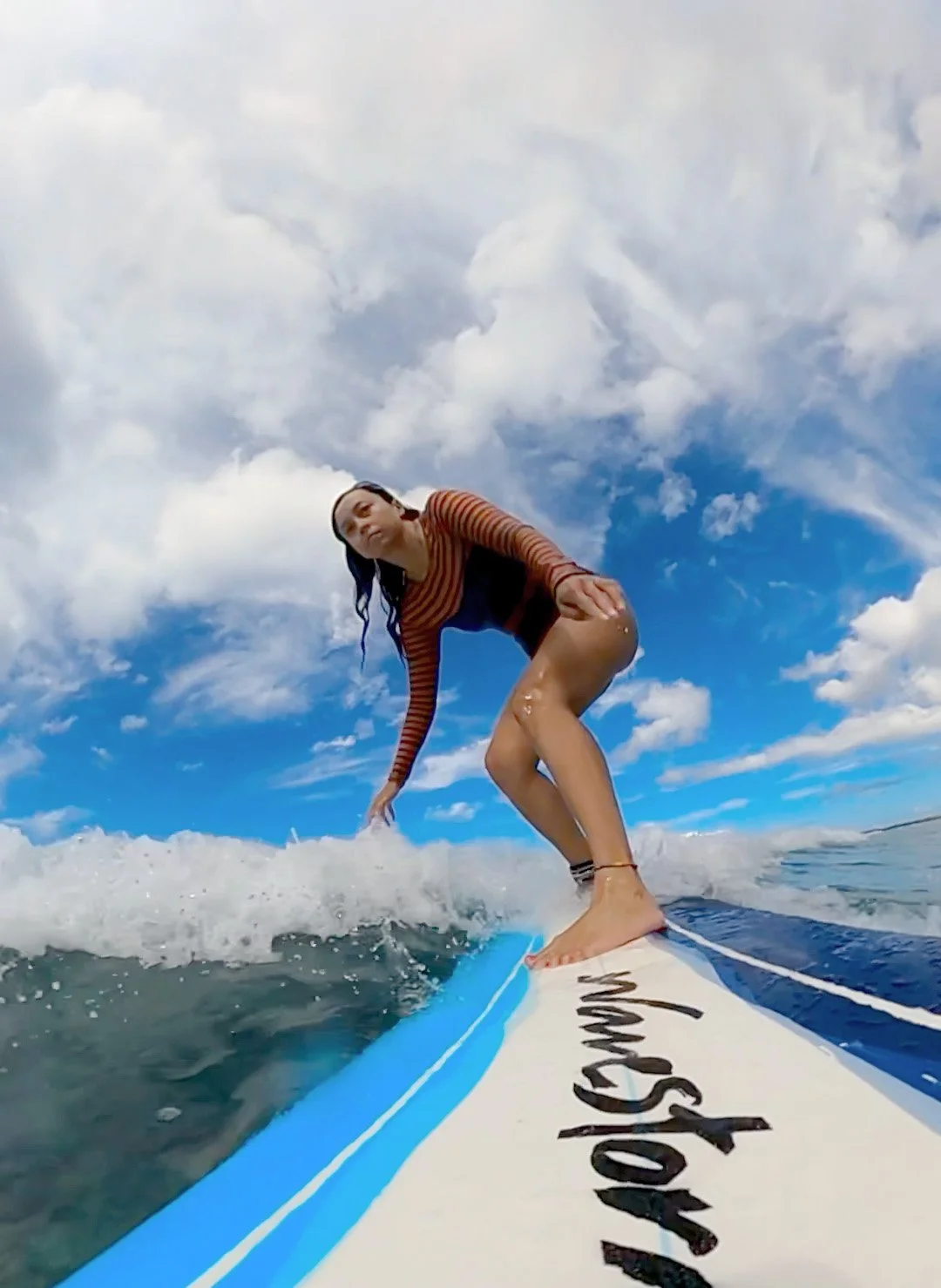
Surfing an unimpressive one-footer in Maui in 2023. I have surfed much bigger waves, but fear keeps me from paddling out unless the surf is tiny.
I flew constantly. I summited 14ers. I surfed, swam and dived in the ocean, sailed in big swells. I panicked, cried, tried breathing techniques, ran through grounding exercises. I got prescribed a low dose of lorazepam “for flight anxiety” and carried it everywhere. Taking it felt like hitting an anxiety mute button—which was helpful to have in my pocket, even though I rarely allowed myself to take it (I hated the idea of relying on medication).
At one point I got really into surfing, determined to make my dad proud. I’ve probably put in close to 100 days, and got decent at catching waves. But anything bigger than a mellow two-footer, and my heart rate would spike and I’d paddle for my life back to shore.
Same with scuba diving. I’ve logged around 60 dives, including advanced and deep dives—but if I think too much about depth, I can still psych myself out. One of the only full blown panic attacks I’ve experienced was while 120 feet underwater in Malta. It came out of nowhere, and wow what a terrible place to lose one’s shit.
I thought that experience would diminish the fear, but it didn’t significantly. In 2024, I spent the entire summer open water swimming in Santa Monica with a coached group. The first few days, I wasn’t even willing to go deeper than waist-deep, but over time I managed to get out and join the swims. Still, some days I’d look at the waves I had to get through and couldn’t bring myself to do it. I stayed on the beach, crying and angry with myself.
I also thought that education would build my confidence, but it didn’t. I’ve accumulated an extensive list of training, courses, certifications, and licenses—everything from high-altitude medicine to CPR to wilderness first responder… the list goes on. I’m beyond competent and knowledgeable in my fields of interest, and I know how to handle worst-case scenarios—but I still had no confidence in myself.
They say “you have nothing to fear but fear itself,” and I completely agree. It wasn’t drowning, or sharks, or getting hurt or dying that I was afraid of—I was really only afraid of my own anxiety. That in the environments I put myself in, it could override my judgment and actually put me in danger.
I started creating these imaginary limits—what waves were too big, what depths were too deep, how far from shore was too far. I stayed inside them like they were real. It didn’t stop me from doing these things, but it drained the joy out of them.
Maybe that was the point. I wasn’t chasing fun—I was chasing fear, challenge, growth.
So… freediving.
Years ago, a friend took a breath-hold class with some guru while working on an underwater set for a huge-budget movie. After just one session, he could hold his breath for over three minutes. Having always been “pretty good” at holding my breath (for like 90 seconds), that amount of time sounded crazy—so it stuck with me that he was somehow able to learn that in just a day or two.
I thought maybe if I could hold my breath longer, I wouldn’t be so afraid of getting held down by a wave while surfing, or drowning in the ocean.
I had no idea that freediving was a sport, I thought it was just something that spear fishers or big wave surfers did.
Then eventually I saw The Big Blue (Le Grand Bleu) and later The Deepest Breath. They showed me that people competitively dive to crazy depths, which was terrifying and fascinating. My impression was that it was something that extreme (and slightly suicidal) people do, not an activity that is safe or accessible to an ordinary person.
Still, I knew I wanted to learn to hold my breath longer and comfortably (and casually) dive down underwater. I keep a running wish list in my notes app of places and I want to go and things I want to do, and for years “learn to freedive” has been on that list. Then one day I saw my friend, Chris Brinlee Jr. in the Red Sea doing exactly that. I reached out to him to ask what he was doing and how it all worked, and within a week or two I had my flight booked. It was also conveniently the excuse I’d been waiting for to finally go to Egypt.
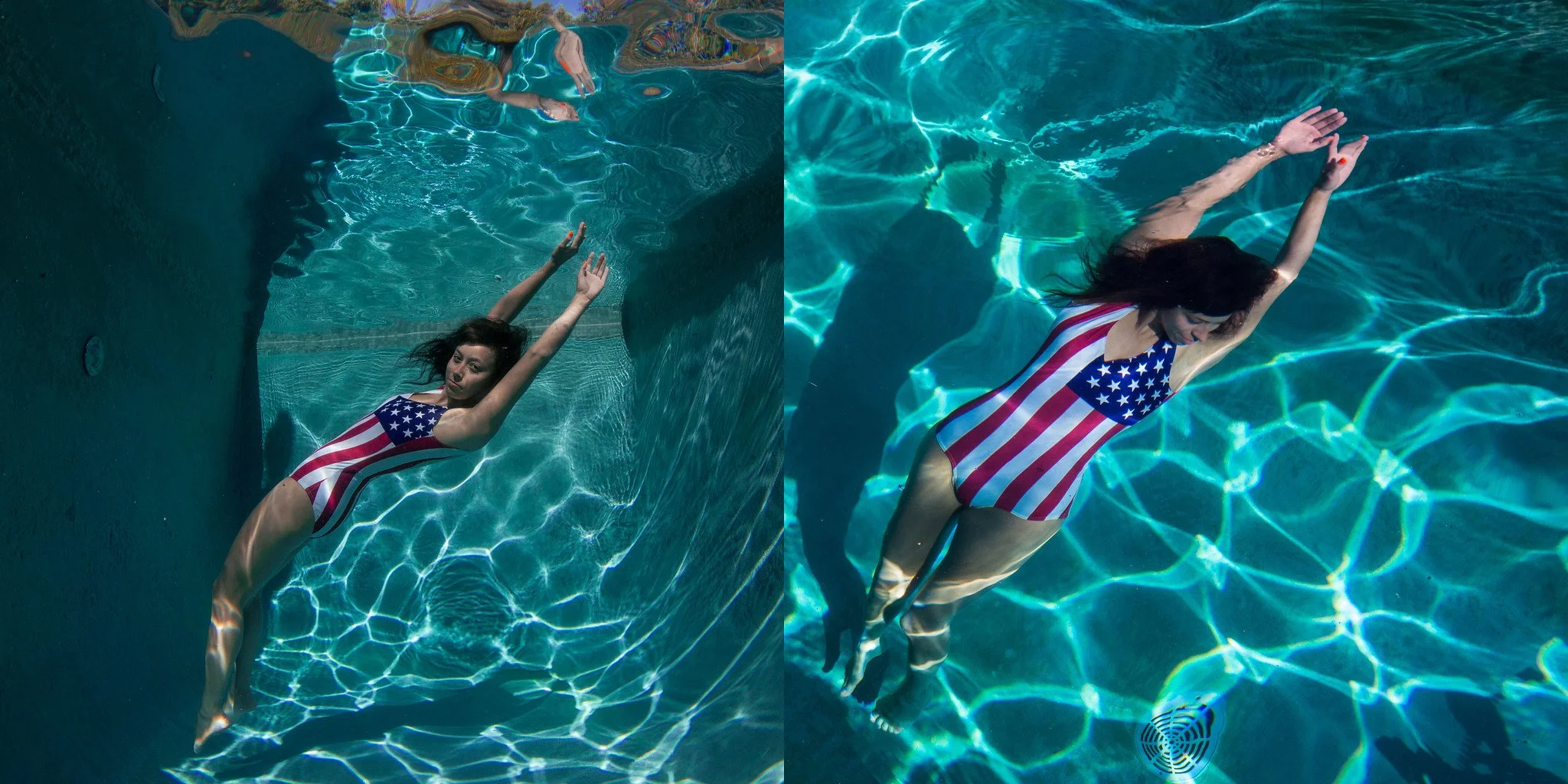
Shot by my friend Dan Kitchens in 2013. At the time he commented on how I was great at holding my breath.
Learning to Freedive
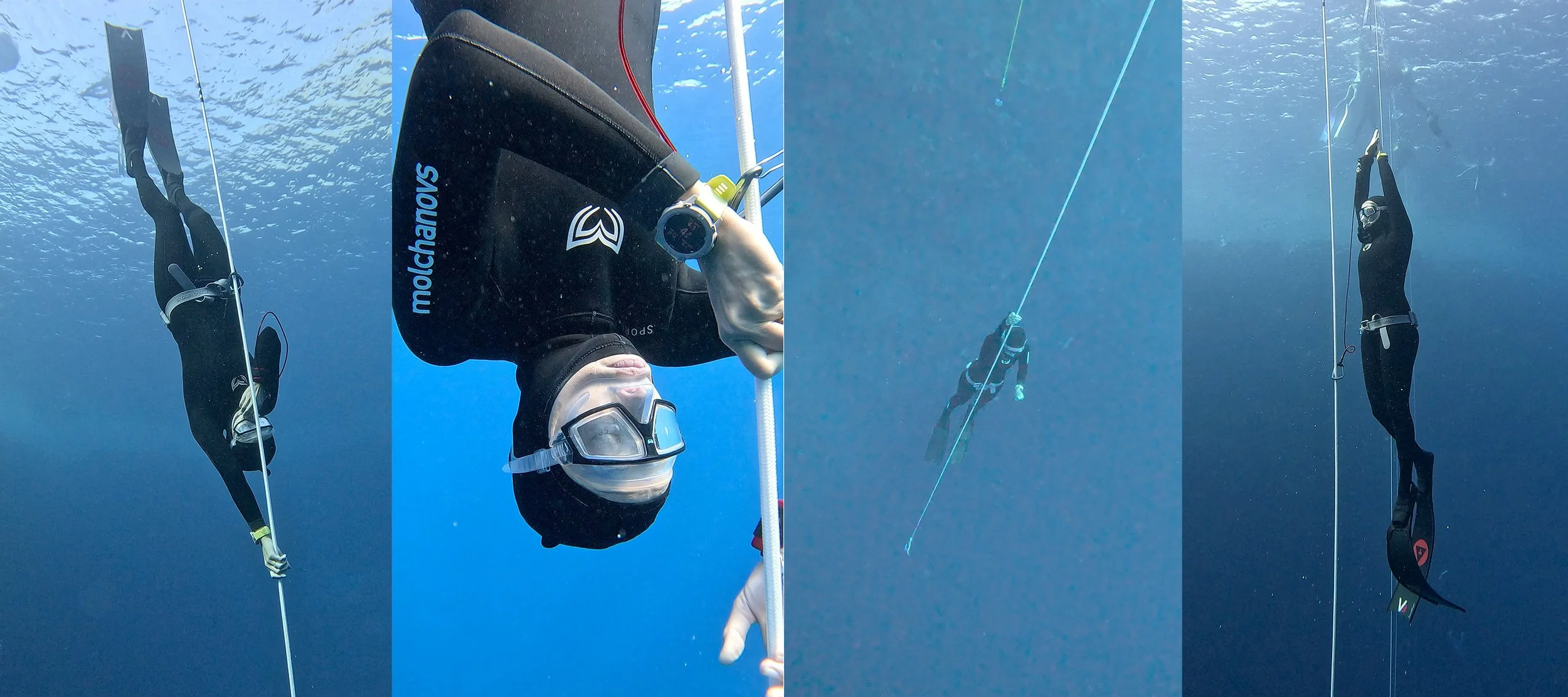
Video stills of me freediving in Dahab’s Blue Hole, November 2025
The intro freedive course (oddly called AIDA 2) starts with learning a bit about anatomy—how your lungs work, what happens to your body under pressure at different depths—followed by learning how to relax and breathe. Most of the time we are shallow breathers, using only our chest, but to utilize your full lung volume you need to properly engage your diaphragm and “belly breathe.”
One of the most important things you learn early on is that you should never hyperventilate before a dive. A lot of us have practiced holding our breath and learned the trick that if you breathe really fast beforehand, it feels like you can hold your breath longer. But it’s dangerous. You’re essentially delaying your body’s built-in alarm system for rising CO₂ levels, which means you can black out underwater without warning—and ultimately risk drowning.
So the rule is simple: relax and breathe calmly and naturally, take one full deep breath, and then hold it.
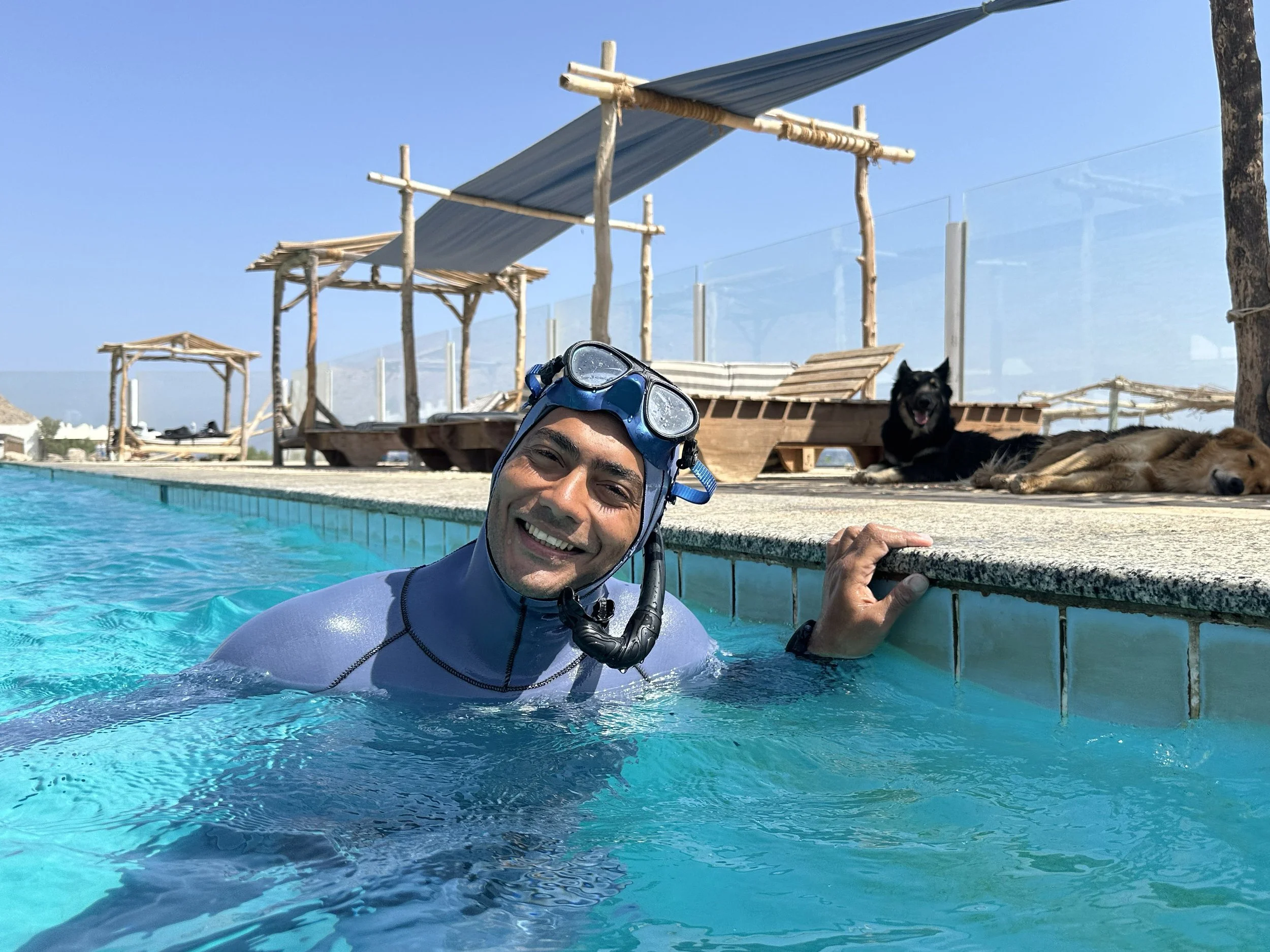
The one and only coach Ahmed “Bambino”, who runs One Breath Freediving school in Dahab, Egypt.
Once we got into the water, I was honestly surprised by how quickly things started to click. I was learning all of this with my instructor, Coach Bambino (@one_breathak)—a funny, charismatic (and hunky) Egyptian guy who had left behind a life as a successful but unfulfilled architect to pursue freediving, and now teaches in the Red Sea town of Dahab.
After learning proper relaxation and preparation breathing, I could hold my breath for 2 minutes and 58 seconds out of the water, and I managed to swim 48 meters on a dynamic (swimming the length of the pool underwater with long fins).
I felt confident holding my breath in the pool, but I was full of doubt about how I would perform in open water. I had no expectations, and put my full trust in Coach Bambino.
Free immersion is a type of freediving where you pull yourself down and back up along a weighted rope. This is what we started with, just going down a few meters at a time and focusing on relaxation and equalizing our ears. On my first session, I made it to around 15 meters (about 50 feet) deep, which already felt surreal. By day two, I managed to do a very long dive (only going down to about 10 meters, but hanging out there on the bottom)—1 minute 32 seconds.
What became clear very quickly is that freediving is not about pushing—it’s about doing less. Relaxing, meditating, and basically not thinking is the foundation. The second your mind starts going—life stress, overthinking depth, ego chatter—you burn oxygen faster and everything falls apart. You have to slow your heart rate and stay present before and throughout the dive. This was easier on some dives than others, but the nice thing about freediving is that each dive is only a minute or so, so you always have the opportunity to try again, which relieves a lot of performance pressure.
I assumed I would be bad at this because of my anxiety, but something was clicking. Being in and under the water was forcing me—for short spans of time—to meditate and calm my mind. And as a result, not breathing felt… really good.
I didn’t expect to do so well or to like freediving this much, but when I did, I decided to continue on to AIDA 3 to learn how to go deeper. And that’s when things got more challenging.
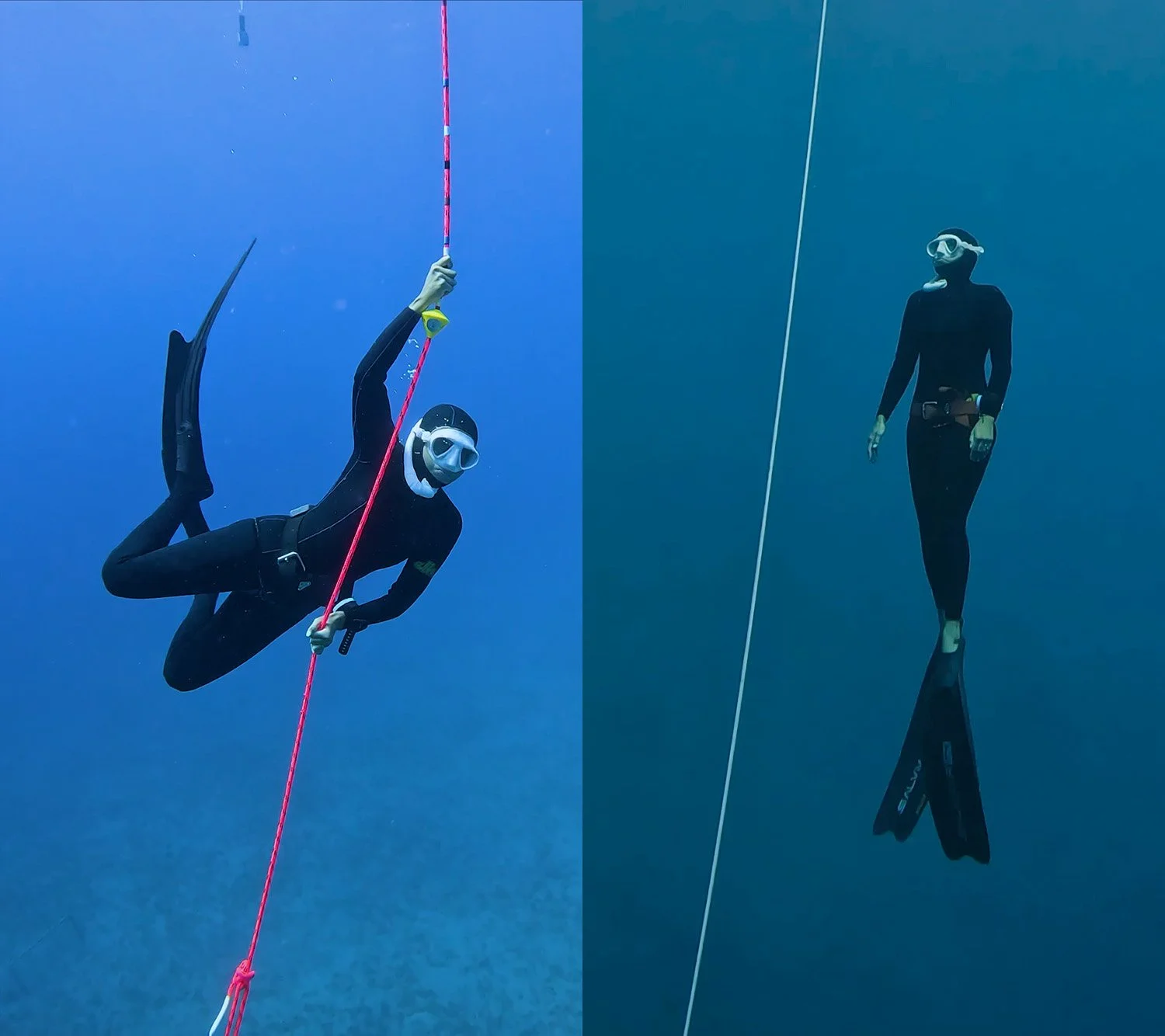
Stills from some of my first dives, in Dahab, Egypt, October 2024
The next day, the weather turned windy and the surface was choppy. Just relaxing on the surface between dives became difficult, and I could feel that tension carrying into the water. I still reached a surprising new max depth of 19.2 meters, but I was struggling with anxiety in my mind, and tension in my body.
The following day, I hit a wall. I was trying to get to 24 meters, but everything past 20 didn’t feel good. At that depth, your lungs are significantly compressed—half their volume at 10 meters, one-third at 20, one-quarter at 30—and it’s something you have to both physically adapt to and mentally relax through. The feeling of compression felt very foreign and scary, so I was resisting it, which only makes it feel more intense.
My deepest dive that day was 21.2 meters, and I came up with an intense tension headache that lingered for the rest of the day. Being the hypochondriac that I can be, I feared these new sensations in my body were somehow dangerous… but a little advil, rest, and water turned out to be all I needed.
The next day, I changed my approach. I stopped looking at the depth on my dive watch. Thinking about depth and time adds a lot of anxiety for me—it creates those imaginary limits I’ve always operated within. I needed to dive based on what my body was telling me, not numbers.
On the final dive of my training, I knew the stopper was set deeper than I’d ever gone. I pulled down, trying to stay relaxed as the pressure built in my chest. I thought I was getting close to 24 meters, but I stopped and turned a meter or two early. The pressure felt like too much, and suddenly I thought about how far I was from the surface.
My mind started racing, and I couldn’t breathe to calm myself down.
I panicked, and that made me feel a strong urge to breathe. I kicked hard for the surface—the exact opposite of what you’re supposed to do. I was very scared, and it was a ugly dive.
But as soon as I surfaced, I was fine. After my recovery breaths, Coach Bambino told me to look at my watch—24.7 meters (81 feet).
He had intentionally set the stopper at 26 meters. He knew that “too far” in my head was short of my actual limit, so he placed it a couple meters deeper than the goal.
I thought I had fallen short—but I had reached the goal—despite my fear.
In just ten days, I went from never having freedived to completing both AIDA 2 and AIDA 3.
Since Egypt…
Since starting in October 2024, I’ve kept up freediving, and it’s become my primary pursuit (skiing, sailing, and other activities have taken second place).
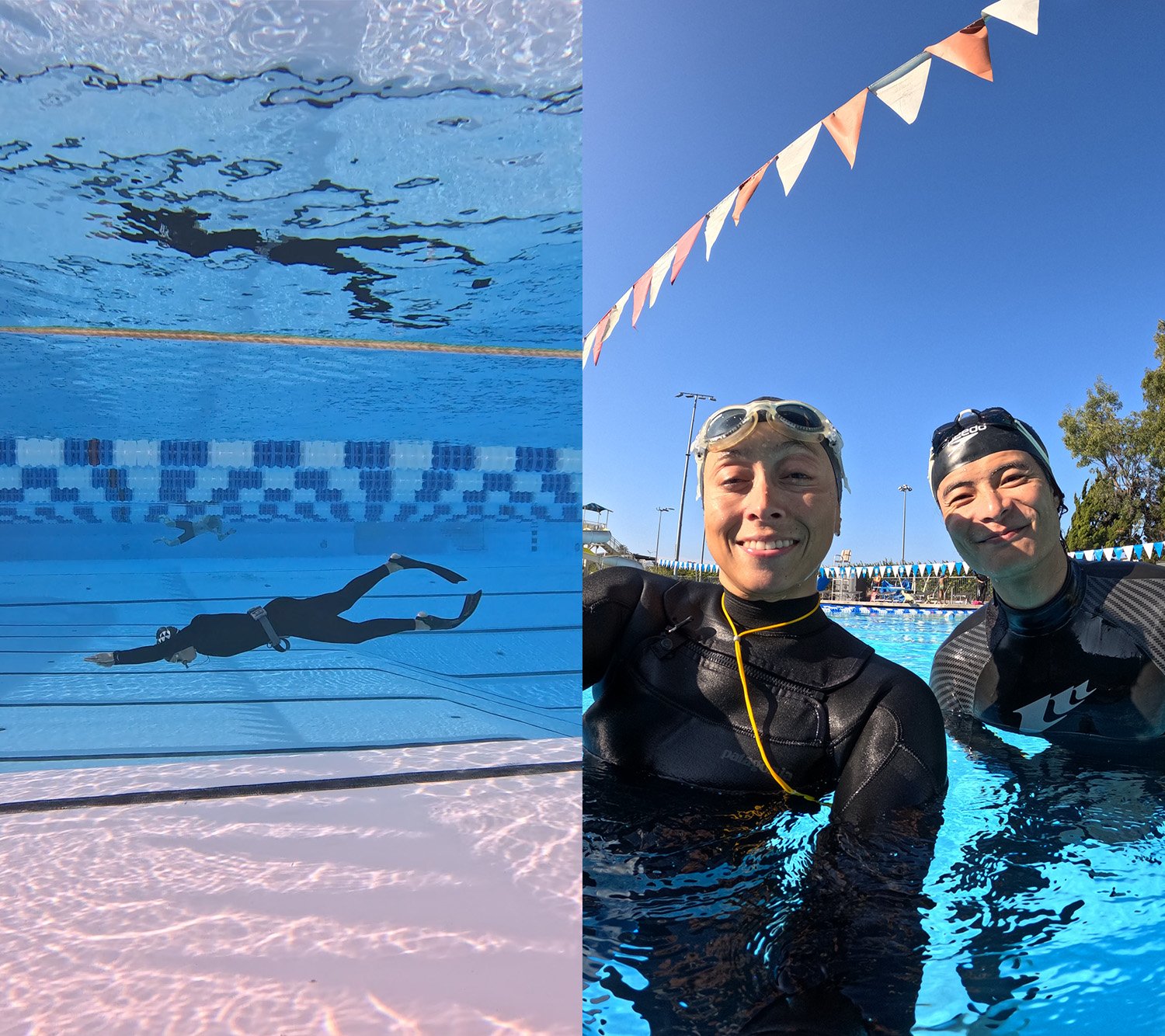
Training with Leslie Taur in the pool in Los Angeles in January 2025
I was reluctant to dive in the ocean in California, so for the first few months after my certifications I focused on pool training while at home in Los Angeles. Freediving in the United States is challenging, because most public pools don’t want to deal with the legal risk of an apnea (breath-holding) related accident—so they prohibit it. I found a few local divers through the SoCal Freediving Buddy Network Facebook group, and we tried out different pools, but were often told to stop during our workouts.
I had a few solid months of consistent training with a buddy, Leslie Taur, a record-holding competitive pool freediver from Taiwan, while he was in town. We managed to find a few pools where a don’t-ask-don’t-tell approach worked in our favor.
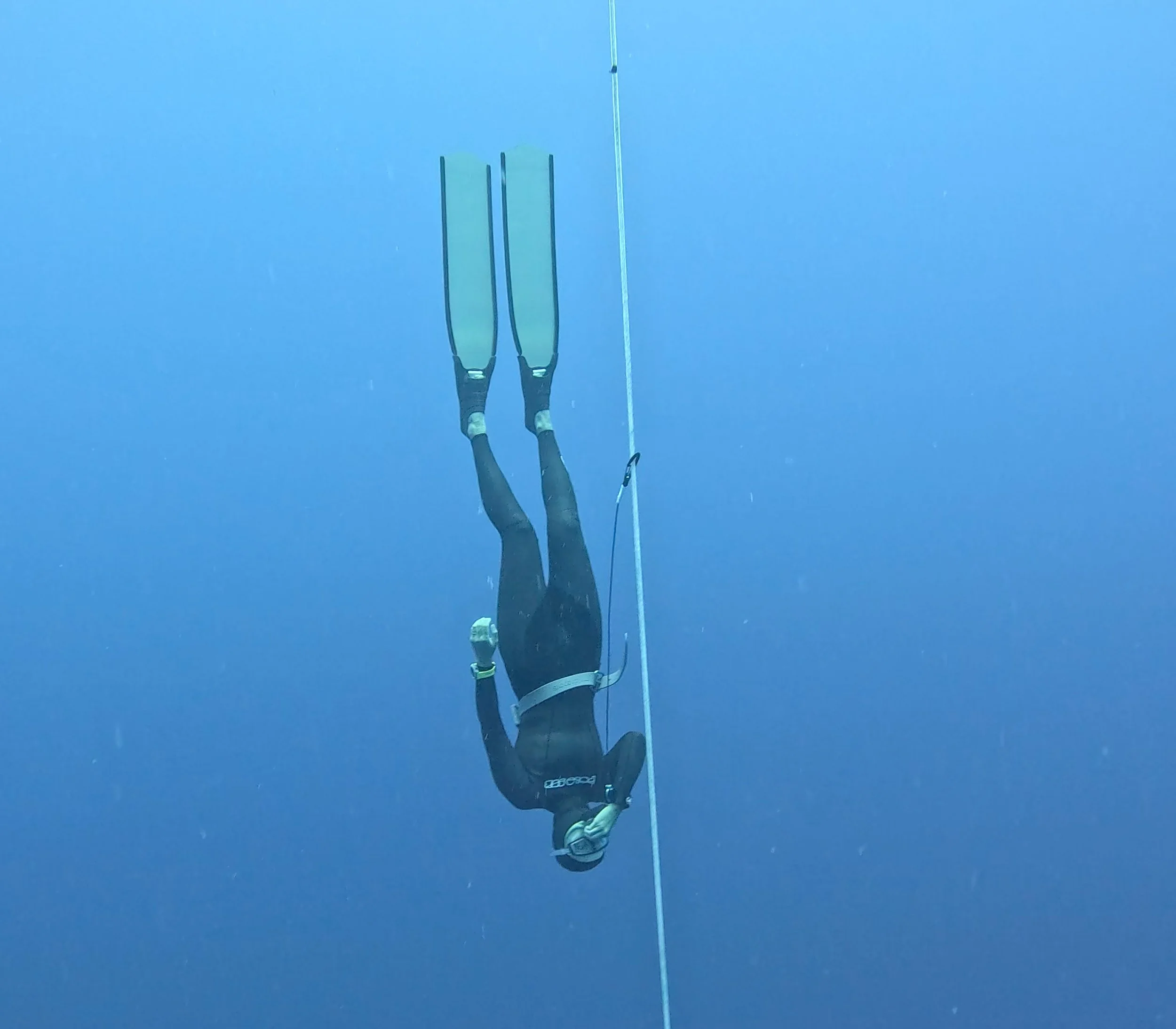
Freefalling on a dive at Honaunau Bay, Hawaii, July 2025
In July 2025, while on a trip to Kona, Hawaii to visit family, I hired an instructor, Dylan Currier (@makaifreediving), who helped me calmly return to 24 meters. We focused on understanding that I was shortening my dives because of a fear- and habit-driven urge to breathe. In reality, I was coming up from my dives with more than enough oxygen in my body (which you can often gauge by how pink your lips are). Dylan explained that I needed to learn to sit with the uncomfortable urge to breathe, and understand that it’s just a signal—not an actual need.
We got me beyond 24 meters, finishing with a very calm and controlled dive to 30ish meters (104 feet)—the maximum depth for my AIDA 3 certification.
After the Hawaii trip, I had the confidence to try diving in Los Angeles. I joined members of the Facebook group to depth dive in Redondo Beach. I was initially very anxious about the long swim out from shore (past the breaking waves), but I found that the training I had been doing—managing anxiety and building comfort in the ocean—was actually working to expand my comfort zone.
I don’t usually hit PBs (personal bests) in LA, because it’s colder, darker water and just a less relaxing environment. I’m also typically diving with safety buddies rather than instructors actively coaching me.
In September 2025, I traveled to Playa del Carmen, Mexico for four days of depth training, where Chris, aka “Elvis” (@freedive_tulum), got me to 33 meters in dark, freshwater cenotes. I loved working with Chris because he really understood—and helped me manage—my mental hurdles, or “worms of the brain,” as he calls them.
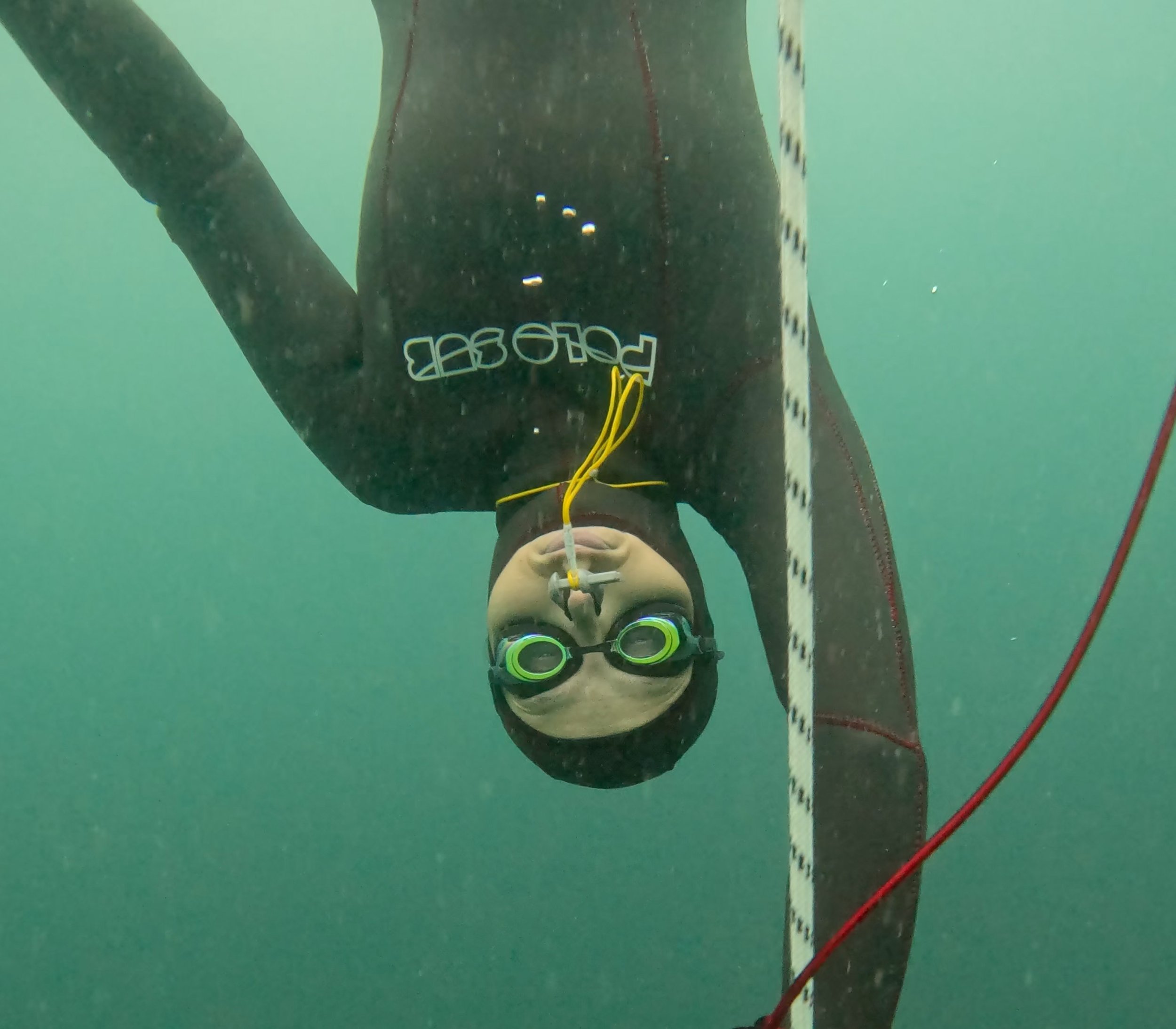
Diving in the cold, cloudy water of Redondo Beach, California
I learned that despite all the training, we all have good days and bad days. Just because you’ve reached 30 meters before doesn’t mean you won’t hit a wall at 20 on another day. This sport isn’t about pushing—it’s about letting go and getting there as a result. And some days, you just can’t let go—and that’s okay.
It helps to understand what the obstacles are—poor sleep, exhaustion, mental noise from consuming news or social media—and work on eliminating those before your next dive day.
In November 2025, I returned to Dahab to participate in a Deep Week freediving event. The event gives participants seven days of diving with several instructors, along with workshops, stretching sessions, and the chance to connect with freedivers from all over the world.
I expected to be hitting new depths every day, but again I faced several disappointing days where my body and mind weren’t ready to go deep. It wasn’t until the final two days that I was able to fully relax—and when I did, I reached 34 meters (and 25 meters without fins).
This time I was following the Molchanovs curriculum rather than AIDA, but they’re more or less the same (Molchanovs just includes no-fins dives in addition to free immersion and fins). I actually love no-fins diving, because it’s similar to breaststroke, which was always my strongest stroke as a swimmer.
After Deep Week, I stayed in Dahab a bit longer to dive again with my OG coach, Ahmed “Bambino.” He was incredibly proud of the progress I had made over the past year, and I got to learn more advanced techniques for going deeper.
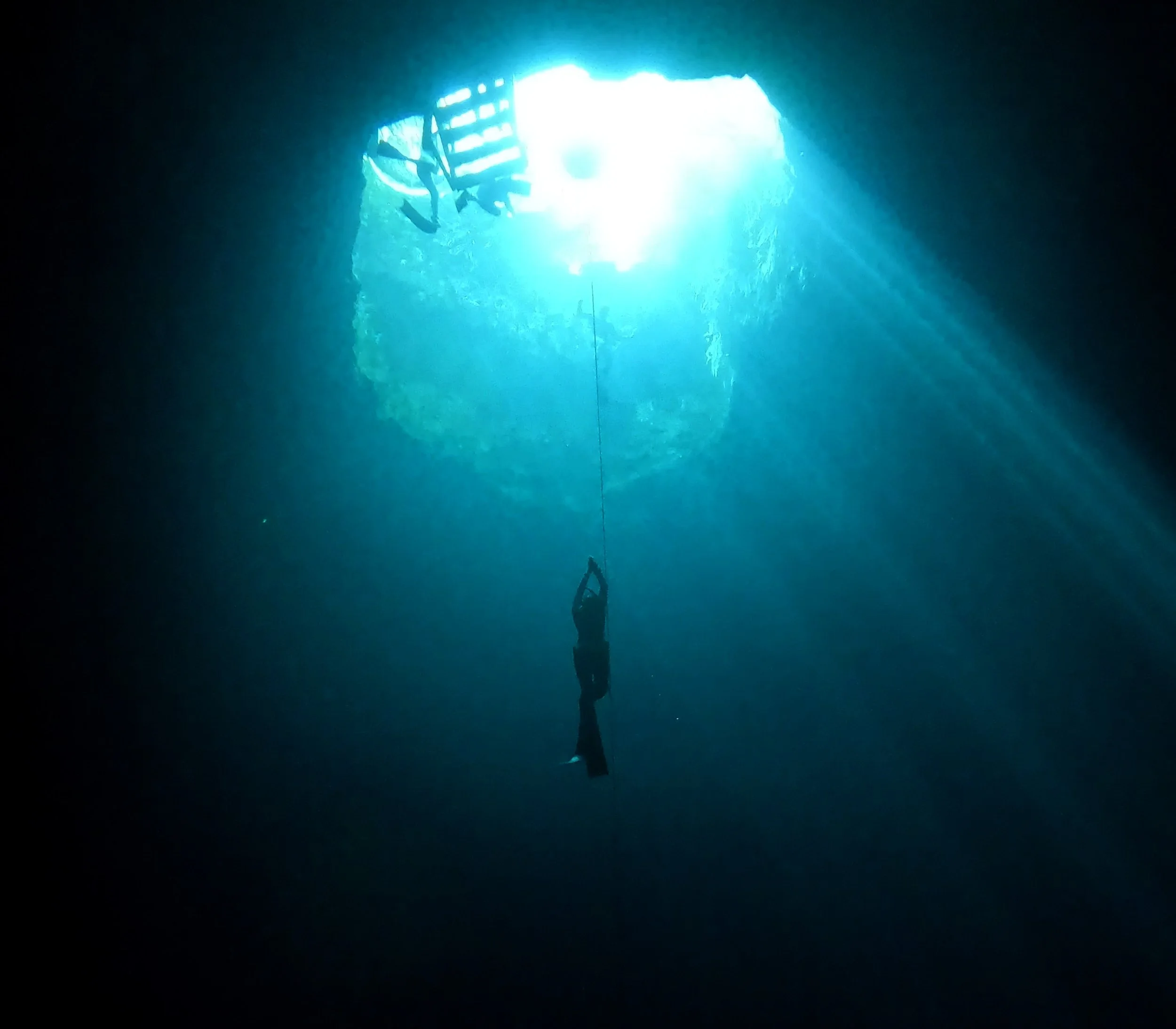
Diving in a cenote near Playa del Carmen Mexico, September 2025
Once you get past 30 meters, it becomes increasingly necessary—if not essential—to learn advanced equalization techniques to manage pressure in your ears. At those depths, your lungs are so compressed that you can no longer pull air from them into your mouth to “pop” your ears, so things get a lot more technical.
With some focus on body positioning and technique, I was able to “reverse pack” and reach a max depth of 37 meters (122 feet)—but only after Bambino tricked me (again) into thinking I was only going to 35.
Since November, I haven’t been back to 37 meters, but I’ve managed to keep 30 meters as a comfortable, repeatable depth—even here in Los Angeles. For a while, I shifted some attention away from freediving and toward other pursuits, like running a half marathon with my sister in January. Now that the disappointing ski season has come to an end, I plan to refocus on freediving.
Even out of the water, I’ve noticed an increase in my self-confidence and a decrease in my anxiety. When I feel it starting to surface, I remind myself that I have not only my mind, but also my breath as a powerful tool to regulate my nervous system. Breathing techniques didn’t work well for me before, but now that I better understand the relationship between breath, CO₂, and the nervous system, I trust the process and let it work. Box breathing (inhale for 4, hold for 4, exhale for 4, hold empty for 4, repeat) has worked to help me regulate myself lately.
On a turbulent flight back from Geneva last month, I noticed myself calmly feeling the erratic movements of the plane—without the urge to spiral, panic, or reach for the meds.
Whenever someone has said that anything I do is brave, I’ve always dismissed it. I thought that if they knew how freaked out I was while doing all of the things I do, they wouldn’t think I was brave at all.
I keep thinking about a quote I’ve heard before—that courage isn’t the absence of fear, but moving through it anyway.